
Now faith is the assurance of things hoped for, the conviction of things not seen.
Hebrews 11:1
If you could edit the Bible, what parts would you cut out?
I might be tempted to take out the book of Joshua, with its violent, merciless battles. I might take some of the vivid language of Revelation out, to minimize wild misinterpretation of it. Maybe I’d leave out a few of the minor prophets–who really reads from Obadiah anyway?
Thomas Jefferson, our third president and author of the Declaration of Independance, went a lot further than that.
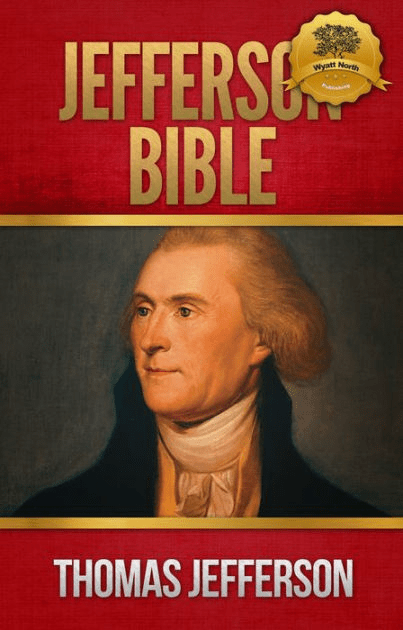
We call it the Jefferson Bible. Its actual title was “The Life and Morals of Jesus of Nazareth”. It was 46 pages long. Using a razor and glue, Jefferson systematically created a version of scripture that was more useful to him.
It had none of the extraneous stuff, like the Old Testament. It avoided the Pauline letters. In fact, Jefferson’s Bible was created solely from Matthew, Mark, Luke, and John.
That was not the extent of his chopping. He cut out every miracle from the stories of Jesus. He kept only Jesus’ teaching. If the teaching was accompanied by a miracle, he cut around the miracle and left the wisdom. In a letter to John Adams, he said:
There will be found remaining the most sublime and benevolent code of morals which has ever been offered to man. I have performed this operation for my own use, by cutting verse by verse out of the printed book, and arranging the matter which is evidently his, and which is as easily distinguishable as diamonds in a dunghill. The result is… 46 pages of pure and unsophisticated doctrines.
Wikipedia
You can actually buy dozens of editions of the Jefferson Bible online. The question is, would you want one?
I’m torn. On the one hand, wouldn’t it be nice to have a simplified, purely rational and reasonable accounting of what Jesus actually did and taught? By taking out the miracles, Jefferson took out the ambiguity, the possible embellishments, and left just the teaching. Just the basics. That could, indeed, be a helpful reference manual for how to go about one’s life.
On the other hand, he’s taking Jesus’ words out of context. Jesus was a rabbi, steeped in the ancient teachings of the Torah. He was a Jew, preaching mostly to Jews. To eliminate that is to eliminate the role of all the prophets and sinners and kings that came before Jesus.
And what would our faith be without mystery? Can a man really walk on water? Could Jesus really restore sight to a blind man? Did the resurrection really happen? (That is a question Jefferson refuses to address. His bible ends with Jesus being placed in the tomb.)
I’ll admit I have lots of questions about the miracles in the bible. I honestly don’t know how to separate exaggeration from fact. But I’ve decided I don’t need to. I read the bible for TRUTH, and that comes to us in a thousand different ways through the scriptures.
Jefferson took out all the juicy parts. The wondering parts, the discerning parts. His naturalistic style valued morals, but not the unknown or unknowable. My left brain and my right brain may argue about how to make sense of it all, but this only strengthens my soul. My faith.
That’s what Jefferson’s Bible lacks–the need for faith. I think of faith as a spiritual muscle–the more you use it, the stronger it gets. Faith is a learned skill, a way of being that points to something bigger than a truth that is “self-evident”. It is an attempt to conceive of the unconceivable.
So what will it be? The 46-page version or the 66-book version? I’m going for the unabridged edition. Maybe one can be used as a tool to help read the other, but in the end, I prefer to view my bible…
as something truly unpresidented.
Have a good week,
Mitch
Leave a Reply